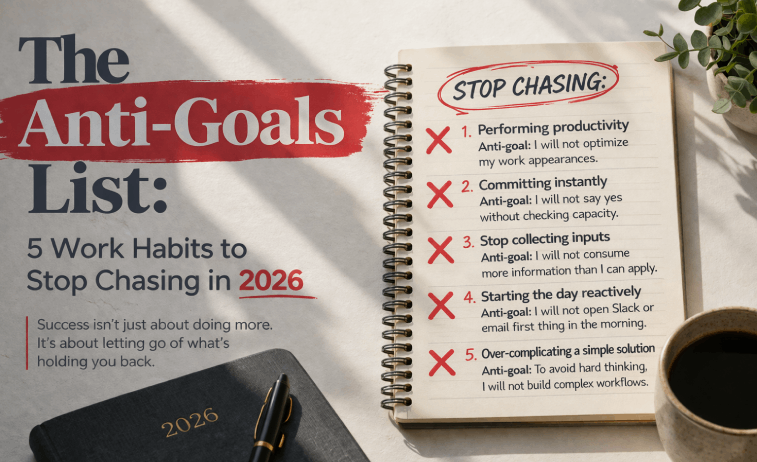
The Anti-Goals List: 5 Work Habits to Stop Chasing in 2026
We don't need another year of squeezing more into already packed calendars.
We have automation. We have AI tools. We have workflow systems layered on top of workflow systems. And yet most knowledge workers feel more fragmented than focused.
So instead of setting bigger goals, try something different: define what you're done tolerating.
An Anti-Goals List is a productivity framework that flips traditional goal settings on its head. Instead of asking "What should I do more of?" You ask, "What should I stop doing?"
The following are the most common anti-goal lists for you to avoid.
1. Performing productivity
Anti-goal: I will not optimize my work appearances.
We're into 'productivity cosplay' where acting fast and staying loud on every platform means you are occupied. But reality is different: your leads don't care about your typing speed; they care about results, and they are their only currency.
Observe senior executives as they work deeply. While they create strategy decks or carefully consider difficult choices, there is radio silence for hours or even days—no chatter on Slack. There are no interruptions, just outcomes.
When you put effort into work and start producing results, your output speaks louder than your activity status.

2. Committing instantly
Anti-goal: I will not say yes without checking capacity.
Mid-level professionals often overload themselves to prove reliability. Senior professionals? They protect their time like it's their most asset, because it is.
When experienced operators get requests, they respond by:
- Let me check my priorities.
- What moves if it moves?
- What is the real deadline?
This is about self-control, not resistance. Deliberate commitments, not blind acceptance, are the path to long-term success.

3. Stop collecting inputs
Anti-goal: I will not consume more information than I can apply.
Podcasts. Newsletters. LinkedIn threads. AI summaries. Endless insights.
Information feels productive. But applied knowledge is what compounds.
If you read ten strategy posts and execute none, you're just intellectually entertained.
Consume less. Implement more.

4. Starting the day reactively
Anti-goal: I will not open Slack or email first thing in the morning.
High-performing knowledge workers protect their first block of cognitive energy.
Instead of diving into inboxes, they tackle one meaningful task before taking on everyone else's priorities.
Once you enter communication mode, your brain switches into response mode. It's harder to return to creation.
Own the first hour. It sets the tone for everything else.

5. Over-complicating a simple solution
Anti-goal: To avoid hard thinking, I will not build complex workflows.
We are starving for guidance while drowning in tools. Software added on top of a malfunctioning process only leads to "automated chaos." A better algorithm is not necessary for true clarity.
If a simple shared document works, use it. If a checklist works, keep it up. Sophistication doesn’t equal effectiveness.

Why Anti-Goals for Work in 2026 Matter?
Traditional goals push professionals to do more. Anti-goals improve performance by removing friction.
By eliminating reactive habits, unnecessary meetings, tool overload, and artificial urgency, you reclaim attention and energy.
In 2026, productivity will not belong to the busiest professionals. It will belong to those who protect focus, prioritize impact, and remove distractions.
Instead of adding more goals this year, start by defining what you are no longer willing to chase.

Frequently Asked Questions
What are anti-goals at work?
Anti-goals are habits or behaviors you intentionally stop doing to improve performance. Instead of adding more targets, you remove distractions, overcommitment, and reactive work patterns that drain focus.
Why are anti-goals important in 2026?
Work today is more automated and connected online than ever. However, with all this technology, it's easy to get distracted and overwhelmed. That's where the idea of "anti-goals" comes in. These are steps professionals can take to limit distractions, maintain their focus, and avoid feeling burnt out from constant notifications and too many different tools at their fingertips.
How do anti-goals improve productivity?
They boost productivity by making things easier. When you stop trying to do everything or get overwhelmed by too much information, you create room for important, impactful work that truly matters.
How does StaffViz support anti-goals?
It tracks results, not activity, helping teams focus on outcomes instead of busy work.
Can StaffViz reduce reactive work?
Yes. It shows task progress and workflow patterns, minimizing the need for constant check-ins and interruptions.
Effectively Manage Remote and Hybrid Teams with StaffViz
Enhance team efficiency and collaboration with StaffViz, the ultimate tool for managing remote and hybrid teams.
Talk To Us