How to Plan and Manage Resources in a Digital Marketing Agency?

First, we need to understand: what is digital marketing agency resource planning? Resource planning for a digital marketing agency involves matching people, skills, and hours available to efforts needed for client campaigns and internal operations. An effective capacity plan will highlight the individuals’ abilities to perform tasks, their availability, and any overcommitments.
Consider a Monday scenario in which two campaigns require new ads, an SEO analysis must be delivered by Friday, and a strategist is off sick. It seems like the team has full headcount from an organizational structure chart; however, there is only one designer who can do the work for one account, and he is already overworked. The capacity matrix will highlight the problem beforehand.
In this guide, we’ll discuss how to create a weekly capacity matrix, assess demand, assign tasks, and analyze results without treating each employee as 40 hours of interchangeable labor.

Why Agency Workloads Become Unpredictable
Client demand outpaces the hiring process
The launch of campaigns, design amendments, reporting requirements, and other adjustments that come along occur between planning cycles. The retainer contract might seem to be stable; however, each week this job consumes completely different hours.
Specialists are not interchangeable
It is impossible to substitute the work of a paid-media analyst with that of a motion designer, for instance. Such workload planning based on the number of employees does not show bottlenecks in skills, approval power, and client expertise.
Real work is non-billable
Meetings, offer preparations, training, project quality control, communications, recruitment; all take time. Failure to account for such activities provides wrong figures of available capacity and results in overburdening of employees.
Time-offs, part-time employment and freelancers affect availability
The availability of employees is affected by such factors as time-offs, holidays, shared freelancers, different time zones, and project turnover.

Creating a Weekly Capacity Matrix for the Agency
This is a very simple matrix showing the realistic weekly working time of the specialist relative to the time he commits to clients and his available capacity. The starting point is the individual and role perspective. Project and skills perspectives will follow afterwards.
Step 1 – Calculating Available Capacity
Start with the scheduled or contracted hours. Deduct from them the leave and holiday hours, recurrent activities that are not related to projects, and other commitments.
Net Assignable Capacity = Scheduled Hours - Leave/Holiday Hours - Internal Commitments - Planning Buffer
For example:
The designer has 40 scheduled hours, 4 internal meetings, and a 4-hour buffer. His net assignable capacity is 32 hours. Buffer hours are an illustration of planning assumptions, not industry standards.
Step 2 – Estimate effort by deliverable, not vague project size
Distinguish deliverables: landing page wireframe, 12 social media assets, campaign QA, keyword mapping, analytics audit, or monthly client reporting. Estimate the deliverables using past actuals and judgment of the specialist.

Step 3 – Assign tasks based on skills needed and deadlines
Each task must have an owner or available skill set, estimated hours, deadline, project or client, priority, and dependencies for approval. A workload may balance numerically but be unworkable if many critical tasks require the same review on Thursday.
Step 4 – Fill the matrix and identify shortages
Compare demands from clients to net available capacity of each specialist. A negative remaining capacity requires that some adjustment occur: scope, scheduling, staffing, or quality considerations.
Step 5 – Resolve Overload Using a Decision Order
- First, eliminate overlapping or low-priority activities and clarify deliverables for clients.
- Second, reschedule important but non-urgent work.
- Third, reassign work to appropriately skilled and available people.
- Fourth, rely on freelance resources when temporary and economically viable.
- Fifth, add staff or adjust services offered in case of persistent shortfall after several planning cycles.
In the given case, reallocation of six design hours to a reputable freelance designer, plus relocation of four hours of paid media to the next week, can fix both specialized overloads, if possible, under client deadlines and contractual arrangements. Log your decisions for all concerned parties.
A Repeatable Resource Planning Process for Agency Teams
Monday – Establish the planning baseline
Import or review current active projects, deadlines, leave, and allocated hours. Clarify priorities with account managers before allocating tasks. Identify tasks that are not clear on scope instead of assuming estimates are firm promises.
Middle of Week – Reforecast instead of reacting blindly
Evaluate time already used, additional client demands, changes made, and any delayed tasks. Calculate how much time is left for the rest of the week. Highlight any skill constraint or schedule problem early on.
Friday – Analyze planned vs. actual work time
Analyze estimates against actual time consumed, determine scope issues and revise estimates for the following week. Focus on the reasons why discrepancies happen instead of using the data to punish people.
Monthly – Make structural decisions
Identify overload situations that are cyclical and related to skill sets, profitability of clients, dependency on certain people, and repetitive use of contractors.
Metrics That Make the Matrix Useful
Avoid setting a universal utilization target across all positions. Activities like account management, mentoring, quality assurance, strategy development, and business development have value even if their time is not billed. A visible 100% occupancy level allows no leeway for disruptions.
Digital Marketing Agency Resource Planning
- Identify all existing client projects and their deadlines.
- Gather leave, holidays, calendars, and regular internal engagements.
- Determine deliverable-specific hours and mark the uncertain ones.
- Assign tasks based on skills, not just availability.
- Plan contingency as realistically as possible.
- Calculate total capacity, assigned hours, and available capacity per person.
- Indicate all negative numbers and same-day deadline clashes.
- Fill in any gaps by rescoping, reprioritizing, reassigning, or external help.
- Review effort used and any revisions halfway through the week.
- Update estimates and hire decisions post-weekly review.
Where Does StaffViz Fit in the Agency Resource Planning Workflow?
StaffViz relates to those stages of the process where accurate information about employees and their projects is required. HR Management in StaffViz allows you to maintain employee profiles, team roles, leave and departmental availability. This provides more data to fill out the capacity matrix. The matrix presented above is an example of a good planning approach rather than a guarantee that such a capacity matrix template exists in StaffViz.
StaffViz HR Management – employee roles, leave visibility and workforce availability.
In terms of execution, StaffViz Project Management Software helps to track task assignments, task assignments based on skills, scheduling, billable and non-billable hours tracking, and project management overall. This functionality can be helpful in tracking employees’ commitments and time, which are used in the recurring capacity review process.
StaffViz Project Management – task assignments, time and project visibility
Resource planning must cover sustainable workloads as well as deadlines. To discuss signs of overwork from another perspective, please see the article on the StaffViz website about recognizing burnout patterns using time tracking.
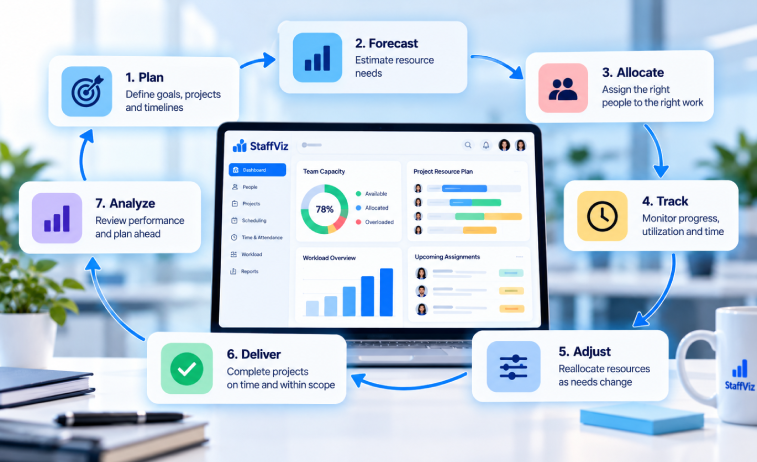
Plan Your Agency Work More Effectively Using StaffViz
Integrate employee availability and project management details in a more cohesive process. Check out StaffViz HR Management for workforce management and StaffViz Project Management for project allocation, tasks, and time management.
Conclusion
Resource planning for digital marketing agencies is most effective when combining realistic capacity, accurate effort estimation at the task level, and a weekly rhythm of decision-making. The key issue here isn't whether the agency has enough people on paper, but whether the right specialists are available at the right time, without overloading them.
Begin with the capacity matrix, look at the overload by specialization, and use project data for improved future estimates.
Frequently Asked Questions
What is resource planning in a digital marketing agency?
It is the process of predicting the workload for the agency's clients and allocating the necessary resources to execute it. A weekly capacity matrix reveals overburdened specialists and looming gaps prior to missed deadlines.
How do you calculate the capacity of an agency's team?
It is the sum of scheduled working hours minus approved leave and internal recurring work, leaving the right contingency margin and comparing it to estimated hours by individual for each project.
What is the difference between capacity and utilization?
Capacity is the quantity of work that the team can accept. Utilization is the measure of how well the available working hours are spent, mainly considering billing. High utilization does not mean a sustainable workload.
How often should agencies update their resource plans?
A weekly plan with at least one mid-week update is a reasonable approach. High-volume agencies or teams receiving many urgent requests might have to update them more frequently.
Should an agency hire if its capacity matrix is negative?
Absolutely not. There are other possibilities that should be investigated first, including scope adjustments, skills shortages, scheduling, and temporary demand.
Can a small agency make a capacity matrix?
Yes, it can. Even an agency of five employees gains from having information regarding the available hours per role, client commitments, and capacity at a glance. Start with a basic weekly matrix.
Effectively Manage Remote and Hybrid Teams with StaffViz
Enhance team efficiency and collaboration with StaffViz, the ultimate tool for managing remote and hybrid teams.
Talk To Us

Table of Content
- Why Agency Workloads Become Unpredictable
- Creating a Weekly Capacity Matrix for the Agency
- A Repeatable Resource Planning Process for Agency Teams
- Metrics That Make the Matrix Useful
- Digital Marketing Agency Resource Planning
- Where Does StaffViz Fit in the Agency Resource Planning Workflow?
- Plan Your Agency Work More Effectively Using StaffViz
- Conclusion
- Frequently Asked Questions