The Truth About Coffee Badging: Productivity Hack or Career Risk?

The alarm goes off at 7:00 AM. You battle forty minutes of rush hour traffic. You arrive at the office, swipe your badge, grab a free oat milk latte from the breakroom, and chat with a colleague for twenty minutes.
Then, by 10:30 AM, before your boss has even finished their second meeting, you’re back in your car, heading home to finish the workday in your sweatpants.
This is coffee badging.
While it began as a viral TikTok meme and a quiet rebellion among Gen Z workers, it has evolved into a statistically significant workplace phenomenon. It is the friction point where rigid Return-to-Office (RTO) mandates collide with the flexibility employees have grown to love.
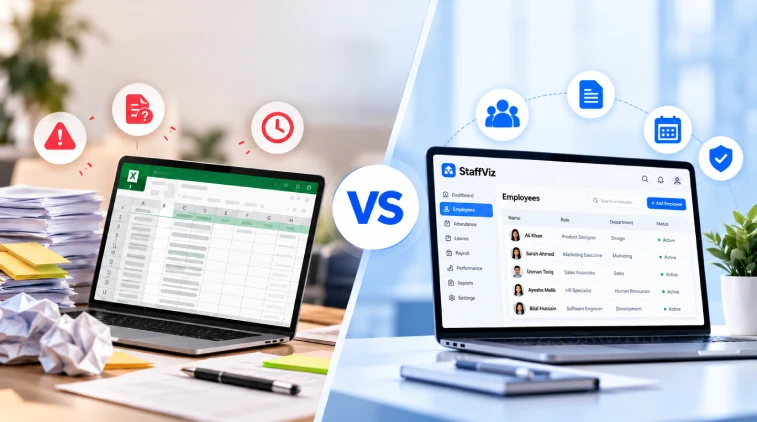
But as we move further into the era of hybrid work, the "swipe-and-go" strategy is coming under fire. With companies deploying sophisticated analytics tools like StaffViz, the days of flying under the radar might be numbered.
Here is the authoritative deep dive into coffee badging: why it’s happening, the hidden risks of "fake" attendance, and how to navigate the hybrid era without stalling your career.
What is Coffee Badging?
Coffee badging is defined as the act of showing up to the office for a superficial amount of time, often less than four hours, specifically to register a "badge swipe" for compliance purposes, before returning to a remote location to work.
The Statistics
This isn't just a few rogue employees. The Owl Labs State of Hybrid Work Report dropped a bombshell statistic: Nearly half of hybrid workers (44%) admit to coffee badging, and another 11% would like to try it, a 38% increase in interest from last year.
This suggests that most of the workforce views the office not as a place of production, but as a place of compliance. They are checking a box.

The Economics of Evasion: Why Coffee Badging Is Rational?
To understand why coffee badging occurs, we must examine the economics of commuting. Gen Z and Millennial workers are naturally calculating their Return on Commute (ROC).
- The Investment: Gas money ($50+ tank), parking fees, expensive city lunches, lost sleep, and 60–90 minutes of unpaid travel time.
- The Return: If they arrive at the office only to sit on Zoom calls with noise-canceling headphones because the open floor plan is too loud, the "Return" is negative.
When the ROC is negative, coffee badging becomes a rational economic response. It minimizes the "Investment" (time spent in a suboptimal environment) while securing the "salary" (by technically complying with the mandate).
“The future of the office must be about intentional presence, not mandated attendance. When the 'why' is unclear, employees will always minimize the 'when'.”
Why Coffee Badging Is Risky: The Hidden Consequences
While coffee badging feels like a clever loophole, it relies on a misunderstanding of how modern companies operate. You might be satisfied with the HR policy, but you are failing the "optical" test of leadership.
1. The "Proximity Bias" Trap
Psychologically, humans are wired for Proximity Bias. This is the unconscious tendency for leaders to favor people they physically see.
- The Risk: If you leave by 11:00 AM, you will miss the spontaneous lunch where a new project is being discussed. You missed the casual 3:00 PM conversation in which the Director asked for volunteers.
- The Result: Even if your output is better than your peers, the "coffee badger" is often passed over for promotions in favor of the person who is physically present when decisions are made.
2. The Rise of "Occupancy Intelligence" (Data Doesn't Lie)
This is the most critical risk factor. Many employees assume their company tracks only those who enter the building. That is no longer true.
Tools like StaffViz provide organizations with Occupancy Intelligence. This goes far beyond the turnstile. Companies now utilize:
- Wi-Fi Triangulation: Tracking how long devices are connected to the office network.
- Computer Activity Monitoring: Using time logs collected by the StaffViz desktop application to determine if the employee is actively engaged at their workstation (Mac, Windows, Linux) while on-site.
- Badge Dwell Time: Calculating the delta between your "In" swipe and your "Out" swipe.
If HR pulls out a report and sees your average "Dwell Time" is 94 minutes, you aren't just seen as someone working from home; you are seen as someone trying to deceive the system. In a time of layoffs and "Quiet Cutting," this data can be weaponized to justify performance improvement plans (PIPs).
From the Manager’s Perspective: Why Coffee Badging Frustrates Leadership?
To hack the system, you must understand the other side. Why do managers hate coffee badging?
It is rarely about "control." It is usually about Commercial Real Estate (CRE) and Culture.
- The Ghost Town Effect: Companies pay millions for office leases. If everyone wears coffee badges, the office feels empty at 2:00 PM. An empty office undermines morale and prompts executives to question why they are paying for space.
- Collaboration Fragmentation: If Employee A comes in from 8–10 AM, and Employee B comes in from 1–3 PM, they both "badged in," but they never actually collaborated. The synergy is lost.

Justified Reasons for Coffee Badging
Coffee badging is typically justified by employees when their commute offers a negligible Return on Commute (ROC) due to specific employer-created inefficiencies:
Mandatory Office Days Lack Purpose:
The policy requires employees to be present on specific days, but managers fail to schedule in-person collaboration or meetings on those days. This forces employees to commute to do deep-focus work in a potentially distracting public office environment (a "Zoom Farm").
Lack of Focus Spaces On-Site:
Modern open-plan offices often lack quiet zones or private spaces necessary for concentration, complex tasks, or confidential calls. If the physical environment hinders productivity, the employee is justified in returning home to their optimal workspace.
Leadership is Absent:
The core value of an RTO mandate is often mentorship and connection. If senior leaders or direct managers are rarely on-site during the required hours, the employee has no opportunity to gain the career benefit (mitigating Proximity Bias) that the commute demanded.
Extreme Commute Burden:
A commute exceeding 90 minutes one way significantly depletes an employee's time and energy. Returning home after essential check-ins is a valid self-care and productivity strategy to maximize focus time.
Policy Ambiguity:
Policies that require "two days in the office" without specifying a minimum dwell time to incentivize employees to meet the rule with minimal effort. The fault lies with the policy's design, not the employee's interpretation.
In these situations, coffee badging serves as passive feedback, signaling that the company's investment in the office is not translating into productive employee experience. The employee is rationally seeking to regain control over their time and maximize output.

Who Is Most at Risk While Coffee Badging?
While coffee badging affects everyone, some groups face disproportionately higher career consequences:
- Early-Career Employees (Gen Z): They need mentorship and network building the most. Coffee badging limits access to senior leaders and necessary coaching.
- New Hires: Establishing trust is crucial. Short stays signal low commitment and make it harder for managers to vouch for the new employee.
- Roles Dependent on Visibility: Sales, internal consulting, and team leads who need to build cross-functional capital are penalized hardest by absence.

Conclusion:
We are currently in the messy middle of the hybrid work revolution. Coffee badging is a symptom of a workplace culture that hasn't yet figured itself out. Companies are learning that strict mandates don't work, and employees are learning that total isolation hurts career growth.
The winners of the next decade won't be the ones who swipe a card and run. They will be the ones who use data, such as insights from StaffViz, to understand when their presence matters most and to show up with purpose.
StaffViz transforms raw attendance and activity data into actionable insights, empowering managers to understand their team’s actual Return on Commute (ROC).
Learn how StaffViz can help your organization implement a hybrid model based on performance and purposeful engagement.
Effectively Manage Remote and Hybrid Teams with StaffViz
Enhance team efficiency and collaboration with StaffViz, the ultimate tool for managing remote and hybrid teams.
Talk To Us

I’m Tracey Taylor, a Content Strategist with over 4 years of experience in B2B and SaaS marketing. I’ve worked with companies like StreamlineREI and StaffViz to drive lead generation and business growth. Outside of work, I explore nature, read books, and play games to stay physically and mentally sharp.