Call Center Absenteeism – 9 Ways HR Teams Can Reduce Coverage Gaps
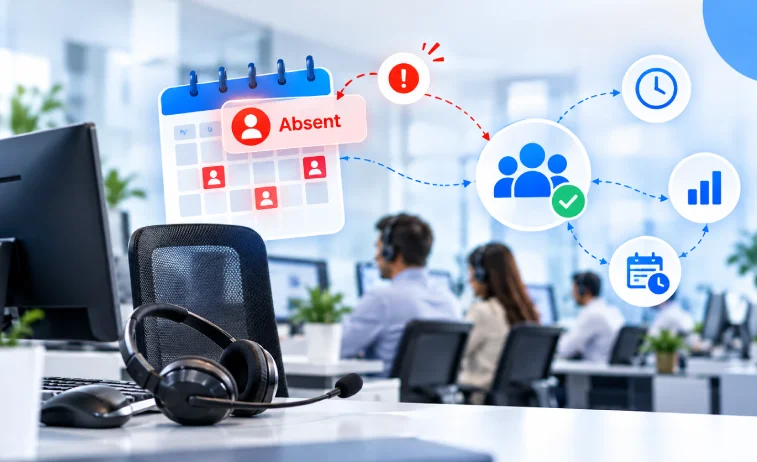
Call center absenteeism can disrupt operations before the start of the first client conversation.
Suppose you manage a contact center with 100 scheduled agents. Fifteen minutes before the start of the morning shift, some employees report that they are unable to work. This means supervisors need to reshuffle schedules, customer queues start growing, and available agents are being requested to answer the calls.
For the HR and operations managers, call center absenteeism is about much more than just scheduling difficulties. Unplanned absenteeism can impact customer satisfaction, workforce costs, employee morale, and operational continuity.
This problem can’t be solved through increased control over the attendance of employees. The key to managing call center absenteeism is learning the reasons behind it, scheduling optimization, promotion of well-being among employees, and coordination between HR and workforce management.
In this guide, you will learn the reasons behind call center absenteeism, how to measure it, and nine ways to reduce this problem. Additionally, you’ll discover how StaffViz HR Management Software and StaffViz Attendance Management Software can make workforce planning more organized.
What Is Call Center Absenteeism?
Call center absenteeism can be defined as a working schedule that employees can’t attend due to absences related to illness, emergency situations, or other reasons covered by the attendance reporting policy of the organization.
The contact center measures call center absenteeism by comparing absent scheduled hours with total scheduled working hours within a certain period.
For instance, when an agent was scheduled for an eight-hour shift but missed it due to some unexpected circumstances, these eight hours might be considered absent scheduled time according to the reporting policies of the organization.
There are two types of call center absenteeism:
- Planned absenteeism: Approved vacation, planned medical appointments, or any kind of leave known in advance.
- Unplanned absenteeism: Unexpected illness, emergencies, traffic difficulties, etc.
Planned leave doesn’t always become a reason for call center absenteeism in operational reports of organizations. Senior management should set consistent definitions instead of blending various categories without explanation.

How is Absenteeism Different from Schedule Adherence?
Absenteeism and schedule adherence are related workforce metrics; however, they are used differently.
Absenteeism is the metric that quantifies the absence of an employee that results in loss of scheduled time. Schedule adherence quantifies the degree to which actual activities of an employee are in accordance with the assigned schedule.
A case where an agent does not turn up for an entire shift would be an example of absenteeism. But when an agent shows up for work and returns late after a scheduled break, it could have an impact on schedule adherence.
Why Is Absenteeism Such a Large Issue for Call Centers?
Call centers need to have an adequate number of trained agents to handle an expected amount of customer queries or complaints. In case of sudden absenteeism, it may be hard for existing employees to meet service-level targets and deliver a seamless customer experience.
1. Long Waiting Times for Customers
In case there is a lack of agents to cope with all the incoming calls, waiting times may increase. During peak hours, it may be hard to achieve the desired service level.
2. Higher Workload for Existing Employees
Unforeseen absenteeism may put extra workload on existing employees. It can be hard for employees to manage back-to-back calls, get some rest between calls, as well as work extra hours.
3. Higher Overtime & Staffing Costs
Supervisors may rely on overtime or additional coverage to compensate for absent employees. For a contact center operating round the clock, this will mean increased costs as well as complications in managing manpower.
4. Declined Employee Morale
The employees may grow annoyed owing to constant substitution of absent workers. In such cases, the issue may extend to employee morale and retention issues.
5. Additional Administrative Burden for HR
Each unanticipated absence could be involved with:
- Recording the absence
- Verifying leave information
- Informing workforce management
- Identifying replacement coverage
- Updating schedules
- Reviewing attendance patterns
- Coordinating payroll records where applicable
When employee data is scattered across various applications, including spreadsheets and messaging apps, the above processes could take more time than needed.
What Causes High Call Center Absenteeism?
Absence reduction requires knowing what causes employee absence. A new policy might solve the problem with ambiguous reporting procedures, but it will not solve the fatigue caused by heavy workloads or transportation problems.
Employee Burnout or Emotional Exhaustion
The call center employees constantly deal with challenging customer conversations, high-performance standards, and the repetitiveness of their jobs. Without proper coping strategies, employees are likely to feel fatigued, frustrated, or emotionally exhausted. Burnout and its related problems should be recognized as workplace health and organizational problems rather than absences.
Unpredictable Shifts in Schedule
Shift rotation, inconsistent start times, and unpredictable schedule modifications can make it difficult for the employees to organize their family life and commute. Predictable shifts would allow the employees to build their lives around work.
Limited Flexibility
Restrictive policies regarding work schedules might cause unnecessary complications in the lives of workers who have valid reasons for having other commitments. Depending on the business’s needs, one may consider shift swapping or pre-planning leaves to achieve some flexibility.
Poor Management Communication
Workers might feel frustrated because of their supervisors’ lack of consistency and fairness when handling various issues like leaves, as well as ignoring any problems in the workplace.
Health and Other Personal Considerations
Health conditions and personal issues such as taking care of someone or being disabled might affect the attendance rate. It is important for the HR department to treat those cases fairly and confidentially.
Employee Turnover and Staffing Instability
High turnover can mean there are less experienced agents to call on, putting more stress on the remaining employees. Even though turnover and absenteeism are different measures, a challenging staffing situation could affect both.

9 Ways HR Team Can Reduce Call Center Absenteeism
There is no attendance management strategy or any software trick that can help end unexpected absence. The way out is to adopt a more holistic process-oriented approach.
1. Clearly Define Attendance Rules
A clearly communicated attendance policy helps employees know what is expected from them and what steps need to be followed. In addition to explaining possible consequences, the policy will clarify the process of reporting absences and how HR will deal with different situations.
It should include such items as:
- Whom employees must contact in case they can’t attend their workplace.
- When and how absences should be reported.
- The process of requesting time off.
- How leave balances and records of absence are maintained.
- Who reviews attendance concerns.
- The way employees can ask questions and correct inaccurate records.
- Policies, like those related to legally protected leaves, should be considered as well.
Practical example: A call center introduces one method of absence reporting that helps HR and workforce managers get information about employees' absences consistently without waiting for personal notifications.
2. Improve Visibility into Employee Leave & Availability
It is difficult for managers to make plans effectively if they do not have visibility into who is available to cover. Increased visibility into leaves will allow seeing what leaves are approved before making any schedules or assigning staff.
HR should be able to have visibility into:
- Approved leaves
- Company leaves
- Days off for the week
- Shifts assigned
- Employee availability
- Departmental staffing needs
In case there are changes, managers should be aware of the changes. If many agents ask for leave during a period that the company is running a campaign, increased visibility will enable managers to review staffing needs before covering more.
How StaffViz fits: StaffViz HR Management offers a company off-days calendar, leave visibility, employee information, and team availability reports that could help initiate a conversation.
3. Devise Backup Coverage Plans
Unanticipated shortages are bound to occur. The contact center must have a strategy that does not involve making things up as they go along. A backup coverage strategy defines what managers will do if staffing is not adequate to meet needs.
Some strategies to consider:
- An inventory of trained employees who can be assigned alternative duties
- Processes for taking on extra shifts voluntarily
- Policies for exchanging shifts
- Process for addressing serious shortages
- Cross-training of essential queues
In the case of a customer support center with several different service queues, a few agents can be identified to work in other queues depending on changing demands. Backup plans should always be consistent with working hour policies, employee qualifications, and any relevant overtime policies.
This is not about eliminating every single coverage issue but minimizing the disruption from an unanticipated shortage.
4. Track Absenteeism Trends Without Micromanaging Employees
Patterns within attendance data may emerge that are hard to detect from isolated cases.
HR personnel and other workforce managers may consider analyzing:
- Departmental attendance trends
- Attendance trends among various shifts
- Unscheduled absenteeism
- Recurring coverage gaps
- Changes in absence rates over time
- Discrepancies between planned and actual attendance figures
However, absenteeism trends need to be carefully analyzed. The rise in absenteeism is not an indication of poor employee dedication in itself; seasonal illness, shift scheduling, fluctuating staffing numbers, and the working environment may all play a role.
Best Practice: Consider attendance patterns and employee opinions about the working environment together before taking any action.
5. Enhance Shift Scheduling and Break Management
Inadequate scheduling can make the challenging task of working in the call center even harder. Workers having a hard time keeping a routine due to unreliable shifts or lack of opportunities to recover will find it even harder to do so.
The HR and operations staff should look at whether the scheduling process allows for:
- Predictability
- Break clarity
- Balanced shift coverage
- Effective peak coverage
- Scheduling communications
- Wage and hour compliance
- Schedule improvements should consider the operation's needs as well as the workers' welfare
Fit for StaffViz: StaffViz provides shift and break management together with attendance tracking features, allowing the team to analyze both the planned and the real attendance data. Enhanced scheduling alone does not necessarily reduce absenteeism, but it can resolve the issues that lead to it.
6. Improve Onboarding Process for Call Center Employees
Recruits can be unaware of how tough call center jobs can be. Lack of proper onboarding can cause issues in handling customer relations, dealing with work pressure, understanding shift schedules and internal processes of the company.
The onboarding process for a call center needs to involve the following elements:
- Creating employee profile and documentation
- Explanations about attendance policies and leave
- Information about shifts and breaks
- Expectations of customer service
- Methods of communication and escalation
- Access to relevant systems
- Specific job training
- Supervision meetings
New hires need to know what to do when they face problems. StaffViz HR Management is helpful in assigning onboarding tasks, collecting documents, making policy acknowledgements and assigning training.
7. Address Employee Burnout Before It Escalates
Preventing burnout is an essential aspect of sustainable call center workforce management. One should keep track of early signs at the team level, like prolonged overtime, workload pressure, employee feedback about fatigue, and growing difficulty maintaining adequate staffing.
Responses to this problem might be:
- Employee check-ins regularly
- Checking workloads and performance expectations
- Making escalation assistance available
- Providing appropriate breaks
- Improving supervisor training
- Reviewing shift allocation
- Handling chronic workplace stress
Employees need to be able to talk about their workload in a secure environment without a risk of getting punished right away. One shouldn’t rely on activity monitoring to make conclusions about employees’ mental state or motivation.
Conclusion: Attendance management works better with the help of support from employees.
8. Improve Coordination Between HR and Operations Managers
The HR and workforce management departments often use the same employee information, yet their responsibilities differ. HR can handle employee data, absences, and administration. Operations can handle service levels, agent coverage, staffing balances, and schedule changes.
Operating independently, these departments can lose time or send the same information twice. A coordinated process for managing absences can include five stages:
- Stage 1: Employee declares an absence using the established procedure.
- Stage 2: HR enters or checks the necessary information on the absence.
- Stage 3: Workforce management analyzes the created gap.
- Stage 4: The operations manager changes staffing if required.
- Stage 5: HR and operations discuss repeated problems at regular workforce meetings.
Both departments should know what they are responsible for and what information they can get access. Centralized information about employees and available workforce can facilitate the process.
9. Review Attendance Metrics and Improve Continuously
Managers need to focus on monitoring their attendance management efforts, rather than simply announcing them.
Some useful measurements include:
- Absence rate
- Unplanned absence hours
- Shift coverage gaps
- Overtime hours resulting from absence coverage needs
- Employee turnover rate
- Admin work due to attendance management issues
- Employees' feedback regarding shift schedules and work conditions
The analysis might be done monthly to understand the trends, but also daily to react promptly to staff coverage issues. In case of introducing improvements, one needs to note what is changed and monitor how it impacts performance over the relevant period.
For instance, after making improvements related to shift scheduling and leave management, the call center might check whether the number of problems with last-minute schedule changes has decreased.
Calculating Your Call Center Absenteeism Rate
The call center absenteeism rate is obtained by calculating the ratio of the absent scheduled working hours to total scheduled working hours and multiplying the result by 100.
Call Center Absenteeism Rate Equation
Absenteeism Rate (%) = (Absent Scheduled Hours / Total Scheduled Hours) * 100
Example: Calculating Monthly Absenteeism Rate
Assume that your call center has the following absenteeism data for one month:
(640/16,000) x 100 = 4%
The absenteeism rate of the call center during that period would therefore be 4% given the categories covered in the absence reporting policy. It simply means that 4% of the total number of scheduled hours was lost because of absence. It neither implies that 4% of employees were absent nor does it determine if it is an acceptable rate.
What Is a Good Absenteeism Rate for a Call Center?
There is no right absenteeism rate for all call centers. Performance will vary based on such factors as the size of the workforce, scheduling policies, reporting policies, geographical location, demographic composition, seasons of the year, and types of absences measured.
Rather than applying a number chosen at random, the Human Resources department should measure against:
- Their own historical attendance data
- Similar departments operating under comparable conditions
- Seasonal absence patterns
- Staffing requirements and service-level targets
- Operationally consistent and consistently defined industry benchmarks, where available
- A useful measurement system prioritizes consistency and context
Which Attendance Metrics Should Call Centers Track?
Tracking these measures together gives HR teams a more complete picture than relying on a single attendance percentage.
How Can HR Management Software Help Reduce Call Center Absenteeism?
HR management software assists call centers in organizing employee data, enhancing leave management, planning schedules, and assessing attendance trends. It helps to make informed decisions but cannot fully solve the problem of absenteeism.
In case the information on employees is distributed throughout various applications, even simple attendance-related processes may turn into ineffective ones. Integrated workforce management allows seeing the picture of requirements and availability of employees for the authorized groups of people.

Centralized Information about Employees
The correct profiles of employees allow HR managers to keep information on job positions, departments, reporting structure, employment status and other details. Thanks to StaffViz HR Management, HR specialists can keep centralized information about employees instead of using only documents.
Improved Leave and Availability Planning
Information about scheduled employees, approved leave, and potential understaffing issues in some departments can be helpful in planning. StaffViz HR Management includes the company calendar, leave management, and team availability.
Attendance Tracking and Trends Analysis
StaffViz's Attendance Management features provide clock-in/out visibility, attendance reports, shift comparisons, and attendance trend analysis. These features supplement HR Management by providing additional data about workforce attendance trends and patterns.
Shift and Break Management
StaffViz additionally offers shifts and breaks management features, allowing for scheduling working shifts, examining employees' availability, and coping with changes in workforce availability. Together with proper HR management processes, these features may be used to improve coordination in workforce management.
HR Reporting and Workforce Insights
It is useful for HR management teams to have relevant information at hand when analyzing staffing trends. StaffViz provides HR-related workforce insights, such as leave and availability reports, departmental information, and employee progress monitoring. This information can be used when discussing workforce management issues; however, managers should also consider employees' opinions on the issue.
Why Technology Should Support People, Not Replace Good Management
The attendance of employees depends on things that computer programs cannot totally handle. Sickness, stress, childcare, work environment, and individual matters call for intelligent solutions from human beings. The best solution is a combination of useful software along with sensible policy and management.
Checklist for Reducing Call Center Absenteeism for Human Resource Managers
Use the following checklist to help you assess your current attendance management practices.
Attendance Policies
☐ Implement an employee attendance reporting procedure.
☐ Inform employees about leave procedures during onboarding.
☐ Enforce attendance policies consistently.
☐ Ensure that your attendance policies comply with employment laws.
☐ Safeguard sensitive employee information.
Workforce Planning
☐ Maintain updated records of employee availability.
☐ Consider approved leave before creating work schedules.
☐ Determine critical shifts and coverage needs.
☐ Have backup staffing plans in place.
☐ Synchronize changes between HR and operational management.
Employee Support
☐ Provide predictable scheduling where possible.
☐ Be aware of overtime work and excessive workload pressures.
☐ Encourage supervisor contact.
☐ Develop opportunities for employees to voice scheduling issues.
☐ Assess any feedback from your employees on their working environment.
Attendance Monitoring
☐ Define what absenteeism is.
☐ Distinguish between approved leave and absenteeism.
☐ Review attendance patterns by shift or department.
☐ Verify accuracy of data before making decisions.
☐ Assess effectiveness of process improvement initiatives.
Technology and Reporting
☐ Bring together employee data that matters.
☐ Gain better insight into time off and scheduling.
☐ Set up proper access controls.
☐ Check attendance and work availability reports.
☐ Use consistent performance measures for management reviews.
HR manager’s tip: Focus on a few quantifiable improvements per quarter, instead of implementing several attendance policies without a way to measure the results.
Streamline HR Processes of Your Call Center Through StaffViz
Employee management in call centers, considering varying shifts, departments, and locations, becomes more difficult when HR data is stored in various disconnected systems.
StaffViz can help businesses centralize their employee management, onboarding, leave management, and access workforce data with HR Management solutions.
Attendance Management and Shift and Break Management modules of StaffViz will provide additional opportunities for attendance tracking and shift coordination.
From in-house contact centers to growing BPO businesses, StaffViz will help create order in your daily workforce management processes.
Find out more about HR Management in StaffViz to see how it can facilitate your call center business.
Conclusion
Decreasing the number of absenteeism cases in call centers goes beyond checking who shows up.
The best HR practices focus on the causes for absences, which include policies, predictable schedules, leave tracking, health and welfare, onboarding, back-up staff, and interdepartmental cooperation.
These changes will make it easier to manage a fully organized workforce and address sudden staff changes in US-based call centers and BPO companies.
HR managers need to start by tracking absences accurately and finding out what causes them and what needs to be improved. Technology can help with this task.
Frequently Asked Questions
What is an Acceptable Call Center Absence Rate?
Acceptable call center absence rates will vary depending on how absence is defined, the call center environment, its workforce and seasonality. There is no one-size-fits-all target that should be set for all contact centers. It is important to agree on clear definitions, analyze historical data and understand the impact of absences on staffing needs.
How Does a Call Center Measure Absences among Its Employees?
Call centers monitor absences by comparing working hours against actual missed hours due to absences. Information about work schedules, attendance, leave, and workforce can help employees estimate the absence rate and discover patterns.
Does HR Software Assist in Minimizing Absenteeism?
HR software can assist in minimizing absence rates through recordkeeping, leave monitoring and identifying attendance trends. However, changes in absence rates also require employees' involvement, reasonable planning, appropriate policy and addressing causes of absence.
What is the Difference Between Absenteeism and Schedule Adherence?
Absence records the missed working time due to absenteeism. Schedule adherence is the ability of employees to adhere to a set work schedule. Both can be useful for call center managers but must be monitored and managed separately.
How Can Managers Control Attendance Without Micromanaging Employees?
Managers can enhance attendance systems through clear communication, creation of consistent schedules, appropriate reaction to leave requests, analysis of team attendance statistics, and consideration of workload issues. The attendance information must contribute to productive discussions not immediate conclusions about the behavior of an employee.
What Are the Primary Reasons of Absenteeism in Call Centers?
The most popular reasons may include sickness, emergencies, stress, poor work-life balance, scheduling issues, difficulties in commuting, lack of flexibility, and disengagement from work. The reasons are different among various call centers.
How Can Call Centers Handle Last-Minute Absences?
A call center can deal with sudden absences through the standard procedure of informing management, examining the existing availability of employees, determining the replacement possibilities for those who can take up their duties, allocating agents if needed, and informing affected supervisors.
How Often Should HR Managers Evaluate Call Center Absenteeism?
Operations managers can check staffing and absenteeism on a daily basis to handle any shortages; however, HR specialists can conduct weekly or even monthly evaluations of trends.
Effectively Manage Remote and Hybrid Teams with StaffViz
Enhance team efficiency and collaboration with StaffViz, the ultimate tool for managing remote and hybrid teams.
Talk To Us

Table of Content
- What Is Call Center Absenteeism?
- How is Absenteeism Different from Schedule Adherence?
- Why Is Absenteeism Such a Large Issue for Call Centers?
- What Causes High Call Center Absenteeism?
- 9 Ways HR Team Can Reduce Call Center Absenteeism
- Calculating Your Call Center Absenteeism Rate
- What Is a Good Absenteeism Rate for a Call Center?
- How Can HR Management Software Help Reduce Call Center Absenteeism?
- Checklist for Reducing Call Center Absenteeism for Human Resource Managers
- Streamline HR Processes of Your Call Center Through StaffViz
- Conclusion
- Frequently Asked Questions