What is an Employee Management System? Why Do Growing Companies Need a Centralized System
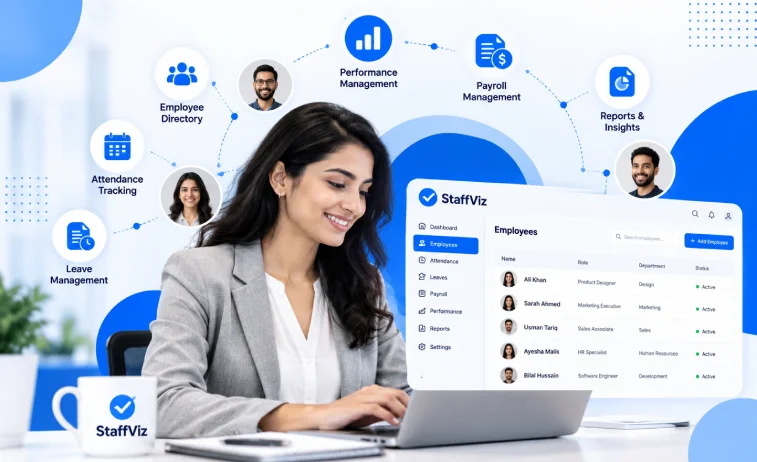
Between the hiring of your 20th and 80th employee, managing your company from memory doesn't fulfil the need anymore. Your leave balances reside in one spreadsheet, shift swaps take place in a chat group, contracts are stored in someone’s email inbox, and payroll is done depending on whether someone reconciles all of the above.
This guide will discuss what an employee management system entails, what research currently shows about the cost of doing it manually, and how you can recognize if your company has grown too much for spreadsheets.
Outgrowing spreadsheets? See how StaffViz unites all the people data, scheduling, and attendance in one interface.
Schedule a free demo
What Is Employee Management?
Employee management is the continuous process of recruiting, onboarding, scheduling, tracking, supporting, paying, and developing your employees, and documenting evidence that you've done it all. Often viewed as "HR administration," it consists of two aspects: an administrative aspect (who works, when, and for how long) and a human aspect (objectives, feedback, and well-being).
It is divided into five categories:
- Documents and onboarding – Contracts, documents, and job descriptions
- Time and attendance – Clock in or clock out, breaks, and overtime
- Scheduling – Shift scheduling and swapping
- Leaves and compliance – Balances, approvals, and labor laws
- Goals and engagement – Objectives, check-ins, and feedback
Small teams can manage all five in a non-formal way. However, growing teams cannot handle it, because every additional team member creates an exception. A part-time worker with customized scheduling, a remote worker from another time zone, and a manager who approves leave via text messages.

Why Growing Companies Need a Centralized HR Management Software
It is not about people in the company but about transfers of information. If any piece of information is transferred from the spreadsheet into the email and then to the payroll database, it can be misinterpreted, overlooked, or an outdated one can be applied. In this case, a centralized system will help to reduce all these transfers to one record.
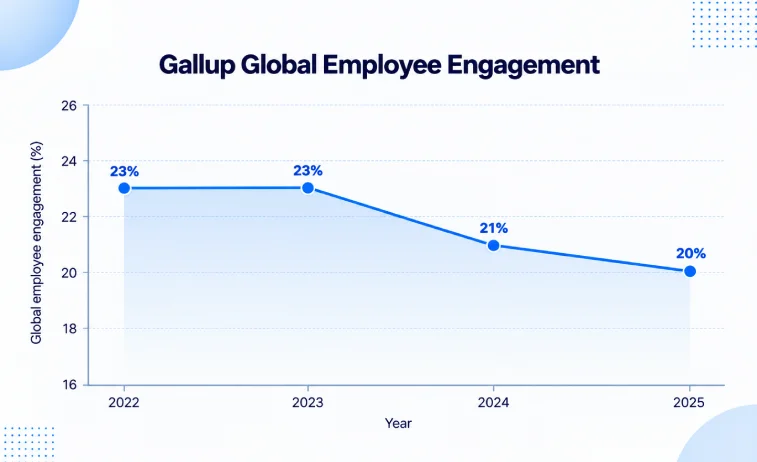
The external data shows the following results.
Here is the Line Graph, representing the Gallup Survey 2026 outcomes
What These Numbers Mean for Scaling Organization
While the Gallup statistics do not imply that administrative inefficiencies lead to the problem at hand, let us assume that the following explanation represents our take on the issue. Gallup points out that managers are the pressure point – the drop in global engagement is linked to a manager crisis. Managers who dedicate most of their week to working on timesheets and approving leaves have little time for coaching. Coaching is what maintains people's engagement. Source – MangoApps
The financial burden becomes clear from the turnover. Gallup provides an illustration of how a 100-person organization with the average salary of $50,000 will experience costs ranging between $660,000 and $2.6 million per year as a result of turnover and recruitment. While software cannot prevent that risk, it can eliminate avoidable factors such as scheduling conflicts, leave approval difficulties and payroll mistakes, which make good employees feel underappreciated. Source – Gallup
Finally, let's talk about compliance. The DOL's Wage and Hour Division enforces minimum wage, overtime and record-keeping laws. Attendance management systems with timestamp capabilities become your primary safeguard, while a spreadsheet with edits of five people does not make a good case. Source – Deeleyinsurance
Indicators That You Need to Move Past Spreadsheets
If any three of these statements ring true for your company, it's probably time to make the switch
- The payroll department must make changes by hand in spreadsheets every month.
- It is not possible to quickly identify how many days an employee has left on vacation.
- Managers maintain their own personal schedules or trackers.
- Onboarding a new hire requires over one hour of administrative work per person.
- Determining who did what during the previous month requires accessing multiple files.
- Preparing reports for leadership involves a weekend of cutting and pasting data.
Spreadsheet vs Centralised System
Below is a tabular comparison between spreadsheet calculations and a centralized system.
What to Look for in an Employee Management System?
Making feature lists is always easy. These features matter as your company grows.
- One profile for each employee used by scheduling, attendance, and leave management
- Mobility options for your shift workers and other managers who do not sit at a desk
- Rules for your overtime, break, and leave policies that work in your jurisdiction
- Permissions that ensure that managers only view the information about their team, not salaries of the whole company
- Payroll integration to avoid duplicate entry of data
- Attendance, overtime, absence, and labor costs reporting
- Pricing options that scale based on the number of employees without being too costly
A quick tip for every demo: make sure that the vendor demonstrates how your software handles shift swapping and overtime overages.

Steps for Integrating a Centralized System without Disruptions
Here are the key steps for the seamless integration of centralized system across your organization.
- Audit the resources at hand. Make a list of all spreadsheets, forms, and chat applications containing people’s information.
- Start solving one problem at a time. Start with attendance or scheduling problems because they concern everyone daily.
- Clean up your data before importing. Duplication and old information get transferred along with everything else.
- Train managers first. Employees will do whatever managers do.
- Do a review after 60 days. Analyze the impact on payroll updates, scheduling updates, and administrative tasks.
Final Words
When your organization grows bigger, workforce management becomes a headache without a centralized system. All these facts are also reflected in the statistics: engagement levels decline globally, turnover hurts you, and wage-and-hour lawsuits cost employers hundreds of millions of dollars annually. An employee management system cannot fix culture by itself but helps eliminate all the administrative issues that take away the energy of managers, lead to miscalculations of salaries, and make you vulnerable from the perspective of compliance with labor laws.
Are you ready to transition from legacy spreadsheet system to a centralized software? Contact StaffViz team and see your own workflow in live demo. Book a free demo.
Frequently Asked Questions
What is an employee management system?
It is a software solution for managing employee data, attendance, scheduling, absences, and performance in one package, which means that both HR and managers use the same data sources.
When does a fast-growing organization need an hr management system?
Most companies start experiencing problems in this area with the number of employees ranging from 20 to 100, as manual data tracking leads to payroll corrections, scheduling conflicts, or inability to quickly generate reliable reports. The size of the team becomes less significant as compared to complexity – for example, several locations, shifts, or types of employment.
What makes it different from HRIS or payroll software?
While HRIS systems manage employee records and HR processes, and payroll software is responsible for wage calculations and payments, an human resources management software designed for a specific workforce includes scheduling and timekeeping in addition to all other processes.
Can an employee management system help ensure labor law compliance?
Yes, it helps by maintaining consistent records with timestamps and automatically enforcing overtime and vacation policies. However, it should not be considered legal counsel; therefore, you need to check the compliance requirements with an expert.
What is the time required for implementation?
It varies depending on data quality and scope. The fastest and least disruptive way to implement the solution is to begin with only one process, like attendance or scheduling.
Effectively Manage Remote and Hybrid Teams with StaffViz
Enhance team efficiency and collaboration with StaffViz, the ultimate tool for managing remote and hybrid teams.
Talk To Us