Automated Payroll vs Manual Payroll: The Complete Guide for Modern Businesses
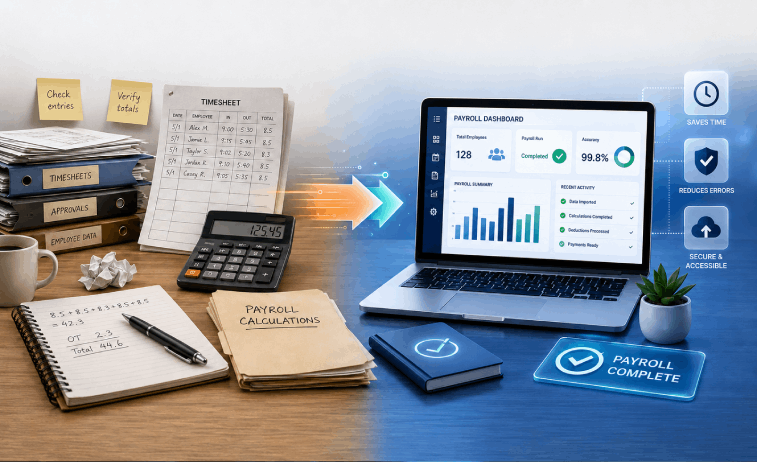
Payroll is the heartbeat of every organization. When it runs smoothly, employees are happy and leadership can focus on growth. When it breaks down, the consequences ripple across the entire business.
In 2026, businesses face a critical decision: stick with traditional manual payroll methods or add automated payroll systems. With over 70% of global organizations now investing in automation and AI-powered business systems, the shift is undeniable.
This guide breaks down the difference between automated payroll and manual payroll, helping you decide which approach fits your business best.
What Is a Manual Payroll?
Manual payroll is the traditional approach where HR or finance teams calculate salaries, deductions, and taxes using spreadsheets, paper records, or basic accounting tools. Every step, from tracking hours to generating payslips, requires human input.
Common Manual Payroll Challenges
While manual payroll seems cost-effective for very small teams, it comes with significant risks:
|
Calculation Errors |
Manual data entry leads to mistakes in overtime, deductions, and tax withholdings |
|
Compliance Risk |
Tracking regulatory updates manually increases the chance of missed changes and penalties |
|
Time-Consuming |
Payroll processing can take hours or even days each cycle |
|
Lack of Scalability |
As headcount grows, manual processes become increasingly difficult to manage |
|
Data Security Gaps |
Spreadsheets and local files are vulnerable to breaches, loss, or unauthorized access |
|
Audit Difficulties |
Scattered records make compliance audits stressful and time-intensive |
According to recent data, 1 in 5 payroll cycles still includes some kind of error, and more than half of all workers in the U.S. have faced issues like late or incorrect payments.
Even more concerning: 1 in 3 employees has quit a job because of payroll problems.
What Is Automated Payroll?
Automated payroll uses specialized software to handle salary calculations, tax deductions, compliance updates, payslip generation, and payment distribution with minimal human intervention. Modern systems integrate with HR, time-tracking, and accounting tools to create a seamless workflow.
Key Features of Automated Payroll Systems
- Automated salary calculations based on attendance, overtime, and leave data
- Real-time tax and compliance updates to ensure regulatory accuracy
- Direct deposit and electronic payment distribution
- Employee self-service portals for payslips and tax documents
- Advanced reporting and analytics for strategic decision-making
- Cloud-based security with role-based access controls
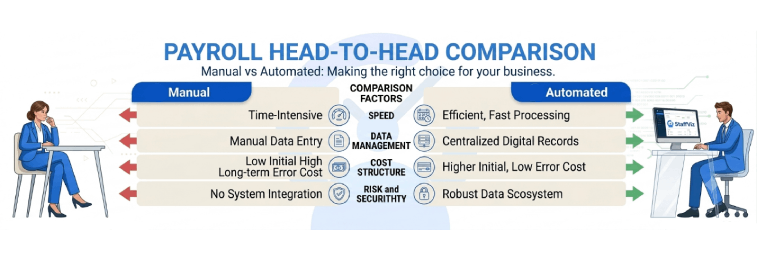
Automated Payroll vs Manual Payroll: Head-to-Head Comparison
|
Factor |
Manual Payroll |
Automated Payroll |
|
Processing Time |
Hours to days per cycle |
Minutes once data is synced |
|
Accuracy |
High risk of human error |
System-driven, rule-based accuracy |
|
Compliance |
Manual tracking of law changes |
Automatic regulatory updates |
|
Scalability |
Becomes harder as team grows |
Easily scales with business growth |
|
Cost |
Hidden costs in labor, rework, and penalties |
Predictable subscription with long-term savings |
|
Data Security |
Spreadsheet/email risks |
Encrypted, role-based cloud security |
|
Employee Experience |
Delays and errors lead to queries |
Faster payouts, transparent self-service |
|
Reporting |
Manual spreadsheet manipulation |
Instant, audit-ready reports |
|
Integration |
Siloed data across systems |
Seamless HR, finance, and time-tracking sync |
7 Reasons Businesses Are Switching to Automated Payroll
1. Dramatically Improved Accuracy
Automated systems eliminate manual calculation errors. Companies using automated payroll report 15–25% fewer errors on average.
With intelligent validation checks and AI-assisted error detection, modern platforms catch discrepancies before they become problems.
2. Faster Payroll Processing
Manual payroll can consume entire days each month. Automated systems reduce processing time by up to 70–80%, freeing HR and finance teams to focus on strategic priorities.
3. Stronger Compliance & Reduced Risk
Tax laws, labor regulations, and statutory requirements change frequently. Automated payroll software applies updates automatically, reducing compliance risk. 62% of payroll professionals believe automation reduces compliance risk.
4. Significant Cost Savings
While manual payroll appears inexpensive upfront, hidden costs add labor hours, error corrections, compliance penalties, and employee turnover. Automation delivers measurable ROI by reducing these expenses over time.
5. Better Employee Experience
Modern workers expect transparency. 83% of employers now offer self-service access to pay information.
Automated portals let employees view payslips, track deductions, and update details without waiting for HR.
6. Scalability for Growth
Whether you're adding 5 employees or 500, automated payroll scales effortlessly. This is critical for startups and SMEs that anticipate rapid expansion.
7. Data-Driven Insights
Automated systems generate real-time payroll analytics, helping leadership forecast labor costs, identify trends, and make informed workforce decisions.
When Does Manual Payroll Still Make Sense?
Manual payroll isn't entirely obsolete. It may still work for:
- Micro-businesses with 1–3 employees and simple pay structures
- Companies in regions with minimal regulatory complexity
- Organizations with extremely limited budgets and no growth plans.
However, even small businesses quickly outgrow manual methods as they add employees, benefits, or compliance requirements.
When Should You Switch to Automated Payroll?
Switch to automated payroll when manual work starts costing you more time than it’s worth.
Here’s when to make the move:
- You have 10–15+ employees: Spreadsheets get messy fast.
- Payroll eats up hours: If you’re spending days on calculations, automate it.
- Pay is complex: Overtime, commissions, and bonuses are hard to track manually.
- Compliance is stressful: Tax laws change. Let software handle updates.
- Mistakes are happening: Wrong paychecks destroy trust. Automation fixes accuracy.
- You’re scaling: Don’t let admin work bottleneck your growth.
Manual payroll might save money early on, but as you grow, automation saves time, reduces risk, and keeps employees happy.
How StaffViz Helps You Make the Switch
Here’s how it helps:
- Easy Setup: We guide you through the process and help move your existing data over. No tech degree is required.
- Stay Compliant: Tax laws change often. Our system updates automatically, so you don’t have to worry about missing a rule.
- Clear & Simple: See everything at a glance on easy-to-read dashboards. No more digging through complex files.
- Happy Employees: Give your team access to their own pay info anytime. It builds trust and cuts down on questions.
- Grows With You: Whether you have 5 employees or 500, the system adapts as your business expands.
- Smart Data: Understand where your money is going with clear reports that help you make better business decisions.
Whether you’re a startup just getting off the ground or an established company looking to save time, automation simplifies the messy parts of payroll.
Final Thoughts
Manual payroll may work when your business is small, but as your workforce grows, the risks and costs increase. Automated payroll gives businesses the accuracy, efficiency, and flexibility needed to manage employees confidently.
With StaffViz, you can simplify payroll management, reduce administrative tasks, and build a smoother employee experience.
Say Goodbye to Payroll Stress
No more spreadsheets, late nights, or “Did we calculate that right?” moments. Let StaffViz automate payroll and keep everything running smoothly.
Frequently Asked Questions
What is the difference between automated payroll and manual payroll?
Automated payroll uses software to calculate salaries, deductions, taxes, and payments automatically, while manual payroll requires HR teams to handle calculations and recordkeeping manually.
Is automated payroll better than manual payroll?
For most growing businesses, automated payroll is better because it improves accuracy, saves time, reduces compliance risks, and scales easily.
How does payroll automation reduce errors?
Payroll automation eliminates repetitive manual calculations and uses predefined rules to calculate wages, deductions, overtime, and taxes accurately.
When should a company switch from manual payroll to automated payroll?
Businesses should consider switching when payroll takes too much time; employee numbers increase, compliance becomes complex, or payroll errors start occurring.
Can small businesses benefit from automated payroll?
Yes. Small businesses can use automated payroll to reduce administrative work, improve employee experience, and prepare for future growth.
Effectively Manage Remote and Hybrid Teams with StaffViz
Enhance team efficiency and collaboration with StaffViz, the ultimate tool for managing remote and hybrid teams.
Talk To Us

Table of Content
- What Is a Manual Payroll?
- Common Manual Payroll Challenges
- Automated Payroll vs Manual Payroll: Head-to-Head Comparison
- 7 Reasons Businesses Are Switching to Automated Payroll
- When Does Manual Payroll Still Make Sense?
- When Should You Switch to Automated Payroll?
- How StaffViz Helps You Make the Switch
- Final Thoughts
- Say Goodbye to Payroll Stress
- Frequently Asked Questions